

From Critique to Contempt: Ireland, Israel, and the Normalization of Antisemitism
Former Irish justice and defense minister Alan Shatter writes that extreme anti-Israel and anti-Jewish sentiment has gone mainstream in Ireland — with the government's tacit encouragement

Editor’s note: Many readers were moved by our recent podcast conversation with Rachel Moiselle about her fight against antisemitism in Ireland (which is now available to all). Today we are publishing this powerful piece by Alan Shatter, who served as Ireland’s Minister for Justice and Equality and Minister for Defense from 2011 to 2014. It is a damning indictment of the country’s political class for its role in fomenting widespread hostility against Israel and Jews — and a cautionary tale about the dangers of incendiary rhetoric gone unchecked. Shabbat Shalom from somewhere in the Pacific. — A.M.
They have been a slow burner.
Neither official Ireland’s hostility toward Israel nor escalating antisemitism in Ireland emerged overnight. They have no single root and follow no straightforward path. Rather, they derive from a convergence of historical and contemporary forces that have shaped Irish political culture. Spread from the top down, they now subconsciously contaminate the outlook of too many who live on the island of Ireland, north and south.
There is a difference between criticism of the Israeli government and hostility toward all Israelis or toward Israel’s continued existence as a state. There is also a difference between criticism grounded in factual, balanced knowledge of history and present realities, and toxic denunciation based on selective facts, distortions, invention, or political opportunism that deliberately ignores context and complexity.
Not all criticism of Israel’s government is antisemitic, just as not all criticism of Ireland’s government is anti-Irish. Israelis and Irish people alike regularly criticize their own governments, and neither state should be immune from international scrutiny. Where criticism is inaccurate, it should be corrected — without vituperation or imputations of bad faith.
But the relentless deployment of emotive falsehoods that demonize a state’s actions while stripping them of context inevitably leads to darker conclusions. When the line between legitimate and illegitimate criticism is repeatedly crossed, identifying underlying causes and motives is justified.
Since October 7, 2023, the actions and pronouncements of the Irish government — successive Taoisigh (prime ministers) and ministers — have all too often crossed that line. The rhetoric and conduct of opposition parties and many elected representatives have gone further still.
For decades, successive Irish governments have favored a two-state solution to the Israeli-Palestinian conflict. I include myself among those ministers and politicians who advocated that position in discussions with Israeli and Palestinian leaders. What is routinely ignored in today’s Ireland is that Arab states rejected such a solution in 1948, choosing instead to seek Israel’s destruction; that Egypt and Jordan between 1948 and 1967 could have created a Palestinian state in East Jerusalem, the West Bank, and Gaza but chose not to; and that two-state offers made by Ehud Barak in 2000 and Ehud Olmert in 2008 were rejected by Yasser Arafat and later Mahmoud Abbas.
Whether any such agreement would have ended the conflict permanently is unknowable. But there is reason for doubt when reflecting on Gaza’s history since Israel’s withdrawal in 2005.
After that withdrawal, Palestinians had the opportunity to develop Gaza as a peaceful, self-governing entity supported by billions in international aid. That was not the path chosen. Hamas instead dedicated itself to Israel’s destruction: constructing hundreds of miles of tunnels beneath civilian infrastructure, initiating repeated wars, abducting Israelis, and ultimately perpetrating the atrocities of October 7, 2023 — atrocities it has promised to repeat.
During the war Hamas initiated and deliberately prolonged, it murdered, tortured, sexually assaulted, and starved hostages, while openly calling for the global murder of Jews. It continued the war by firing thousands of missiles into Israel from locations adjacent to civilians and denied Gaza civilians access to tunnels in order to maximize and weaponize civilian casualties for propaganda benefit. Hamas openly boasts of sacrificing “martyrs” and opposes any permanent two-state solution.
Yet despite this reality, Ireland’s political class has continued reflexively to call for a two-state “solution,” while ignoring Hamas’s responsibility and agency. Palestinians and their divided, incompetent, and corrupt leadership are infantilized and absolved of responsibility for continuing conflict, while Israel is portrayed as solely responsible. With few exceptions, Israel is depicted as the aggressor and rarely as a state defending its citizens in a war it did not initiate.
This mentality — denying Palestinian agency while demonizing Israel — has dominated Irish political rhetoric since October 7. It extends beyond politics into trade unions, civil society NGOs, activist groups, and much of the mainstream media, including Ireland’s state-supported broadcaster, RTÉ. RTÉ’s selective coverage — its routine framing of the conflict as “Israel’s war on Gaza,” reliance on Hamas-run health ministry figures, and presentation of tragic but context-free imagery — has significantly shaped public perception. These narratives are echoed across print media, podcasts, and social platforms and reinforced by the relentless campaigning of the Ireland Palestine Solidarity Campaign and its ever-proliferating offshoots.
There are additional factors that cannot be denied: the inflammatory rhetoric of some Israeli ministers; the violent conduct of a minority of West Bank extremists; abuses of Palestinian prisoners; and instances of excessive IDF force. These warrant criticism. Too often, however, they are deployed selectively to obscure Hamas’s crimes rather than to confront the conflict honestly.
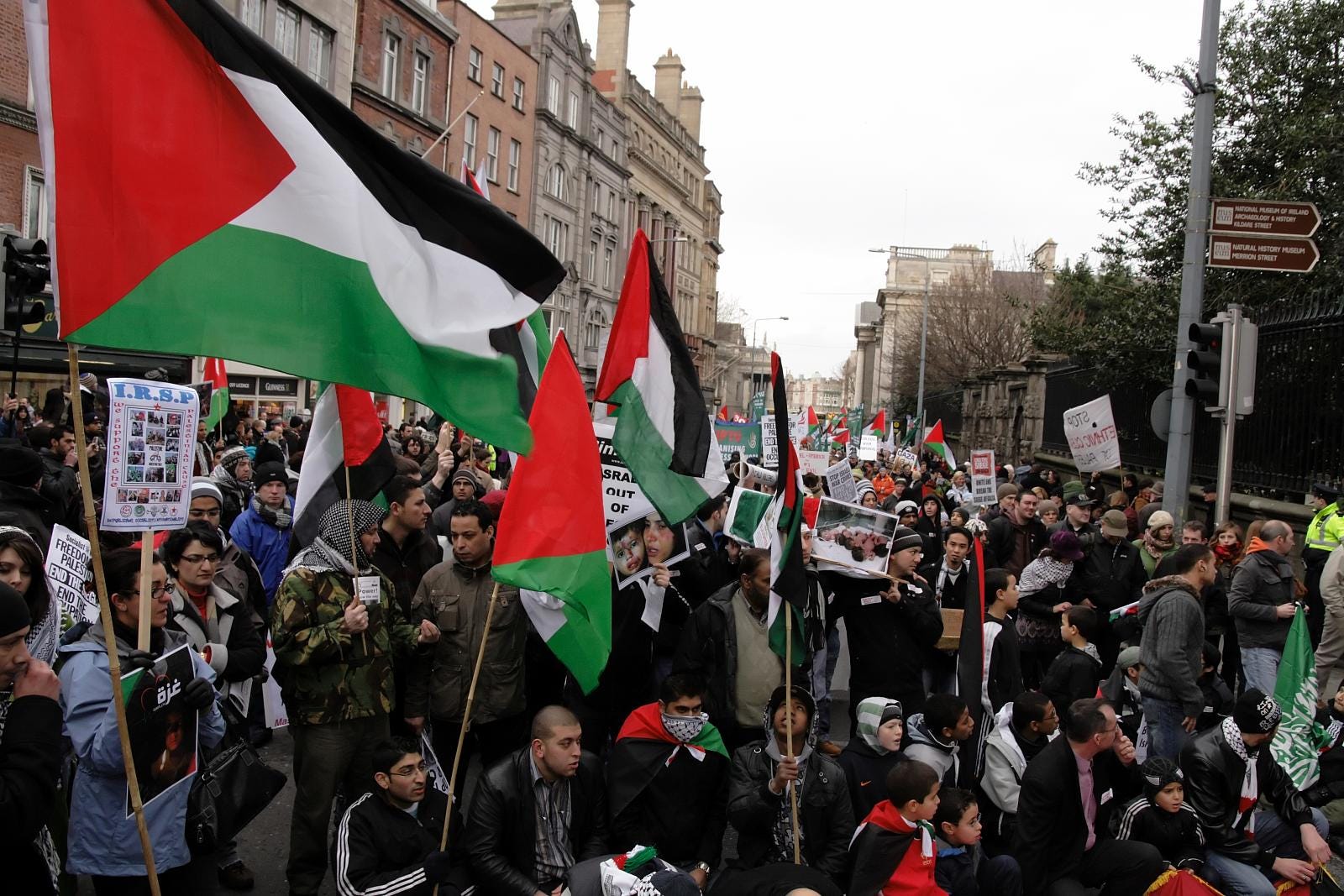
Since October 7, almost weekly protests in Dublin and Cork have become social rituals for students, activists, artists, trade unionists — and antisemites — seeking belonging. Their focus is not peace or reconciliation but Israel’s elimination. Concerts, academic events, and sporting campaigns demonize Israel and promote boycotts, divestment, and sanctions aimed indiscriminately at all Israelis.
For some in Ireland, the Palestinian “cause” has filled an existential void left by the collapse of traditional religious faith. For others, it serves as a vehicle for intersectional ideology and the revival of a Soviet-era anti-colonialist narrative that falsely equates Israel — the world’s only Jewish state — with Britain’s colonial rule in Ireland.
This narrative is most enthusiastically embraced by Sinn Féin, which during the Northern Ireland conflict acted as the political front for the Provisional IRA. Since the Good Friday Agreement, Sinn Féin has grown into Ireland’s main opposition party and embedded itself deeply within trade unions and activist networks. Its focus is the demonization of Israel as an apartheid state and advocacy of BDS. While it preserves strategic ambiguity about Israel’s existence, some members openly advocate its replacement. The smaller left-wing party People Before Profit goes further, openly applauding the “resistance” of October 7 and calling for Israel’s extinction. For some, “Zionist” or “Zio” has become a routine term of abuse, and the only “approved” Jew is a self-declared anti-Zionist. The Social Democrat Party, which replicates the Sinn Féin narrative, in the spring of 2024 deselected its only Jewish member chosen to contest Ireland’s local elections because she privately expressed concern about the impact of its toxic rhetoric.
Since October 7, the Dáil has devoted more time to the Israel-Gaza war than to any other issue, including Russia’s invasion of Ukraine or Ireland’s housing crisis. Even after the UN Security Council endorsement of an international peace framework, the obsession continued. While ritual calls were made for the release of hostages, their release was never prioritised. Absent was any reference to the complexity of tunnel warfare, Iranian sponsorship of terrorism, or Hezbollah missile attacks that endangered Irish UNIFIL troops. The refrain of Israel’s “disproportionate response” became constant. The possibility that the war could end if Hamas simply released the hostages was never discussed. By November 2024, the Dáil unanimously adopted a resolution denouncing Israel as guilty of genocide.
In spring 2024, five months after October 7, Israel’s ambassador was excluded from all Irish political party conferences while Iran’s was welcomed; in May 2024 Ireland recognized a Palestinian state alongside Spain and Norway and was publicly praised by Hamas; in September 2024 Ireland’s embassy in Tehran was reopened; and in November 2024 Ireland supported South Africa’s genocide case at the International Court of Justice, later intervening by proposing that the Court expand the definition of genocide to apply it to Israel’s conduct of the Israel-Gaza war. That December, Israel withdrew its ambassador.
In January 2025, the government committed to the so-called PIGS Bill, criminalizing the importation of goods from Israeli settlements, a euphemism for Jewish-originated goods. The government admits its bill — reminiscent of the darkest periods of Jewish history — is symbolic: the affected trade amounted to €650,000 over five years. If enacted, it would violate the EU’s exclusive international trade competence, trigger U.S. anti-boycott laws, and damage Ireland’s international standing. Its symbolic message, however, is unmistakable: that no Israeli or Jewish person should reside or work in East Jerusalem or anywhere on the West Bank or Gaza, and that any future Palestinian state should be judenrein (free of Jews).
By late 2025, two controversies crystallized these trends: a proposal to rename Herzog Park in Dublin, adjacent to Ireland’s only Jewish school, and RTÉ’s campaign to exclude Israel’s broadcaster from Eurovision. The Herzog Park proposal collapsed on procedural grounds but not before councilors denigrated Chaim Herzog as genocidal and condemned the “crime” of Zionism. Campaigners then sought an “approved” anti-Zionist Jew to replace his name. RTÉ’s failed effort to exclude Israel from Eurovision culminated in its own withdrawal from the competition, defended as “solidarity” by the current Taoiseach but achieving nothing beyond reputational damage.
In today’s Ireland, extreme hostility toward Israel — and antisemitism itself — has become mainstream. Depicting Israel as genocidal is routine. Jewish children face bullying in schools. Irish social media is saturated with conspiracy theories and antisemitic abuse. Journalists and academics who dissent from the prevailing narrative are marginalized; Jewish experts who challenge orthodoxy are effectively silenced.
After the terrorist massacre at Bondi Beach, Irish leaders rushed to condemn antisemitism — many of them having marched at events where chants to “globalize the intifada” were commonplace. The hypocrisy was stark.
It is possible this tragedy will prove a moment of reckoning. It could lead to restraint, meaningful application of the IHRA definition, abandonment of the PIGS Bill, and serious engagement with Ireland’s Jewish community that results in positive action.
But experience counsels skepticism. Politicians are adept at issuing the right words in moments of crisis — and then moving on.
This time, I hope to be wrong.
Alan Shatter served as Minister for Justice and Equality and Minister for Defense of Ireland from 2011 to 2014. He was a member of Ireland’s parliament, the Dáil, for thirty years, and chaired its Committee on Foreign Affairs. Today he serves as a member of the Board of the Israel Council on Foreign Relations and as Chairman of Magen David Adom Ireland.


 | A guest post by
|
Well said. I’m an Irish citizen and disgusted with the Irish Jew hate.
Well written, Mr Shatter. I am also an Irish citizen, and I live in Australia. So my pro-Israel views are doubly frowned upon.
I am old enough to remember a Christian Brother teacher praising Israel for resurrecting Hebrew. He saw it as a model for Ireland and for saving the Irish language. I remember a teenager who went to Israel and worked on a kibbutz. That was the 1960s and 1970s.
What the heck happened?