

On Dreams, Awakenings, and Israel's Next Chapter
The arc of the past two years mirrors the story of Genesis and compels us to follow our biblical forebears' example

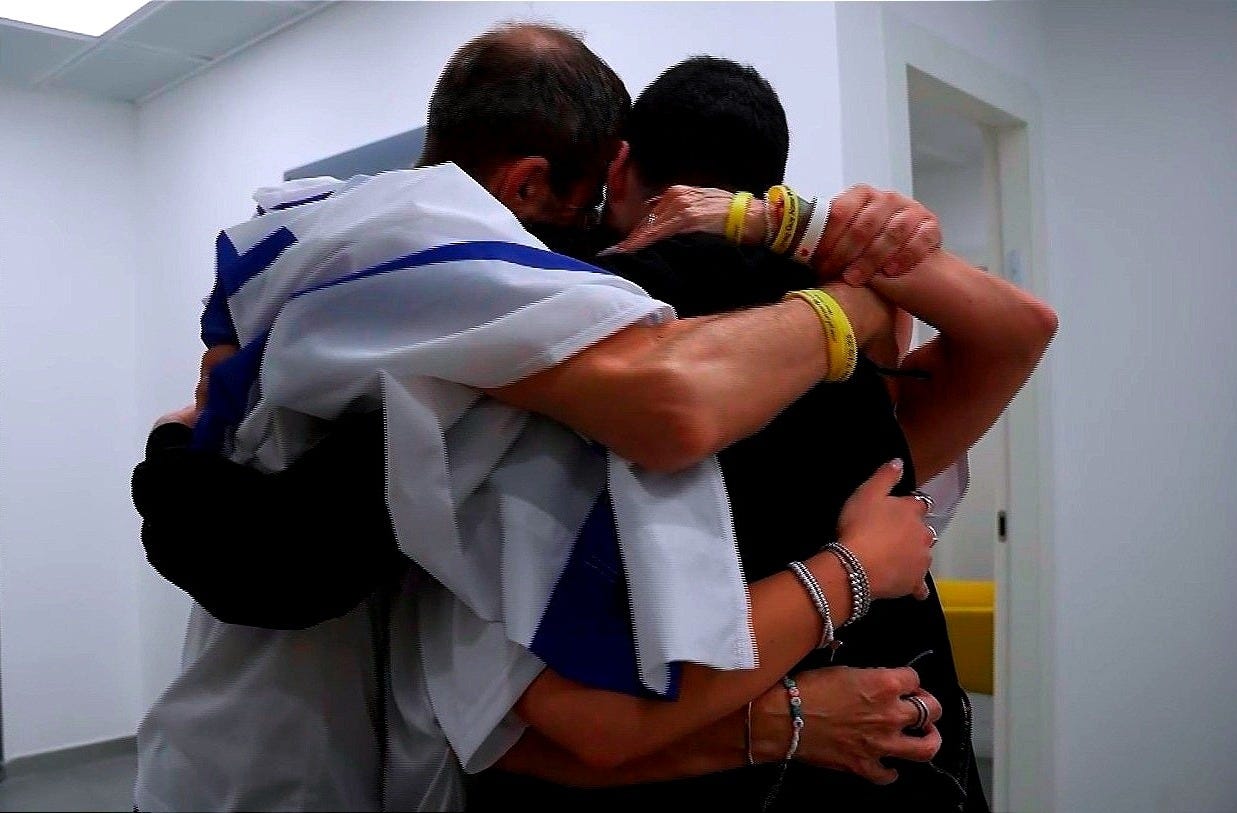
Editor’s note: As families across America (and some turkey-loving expats overseas) gather to celebrate Thanksgiving, I wanted to offer a reflection on this moment in the Torah reading cycle and in Israel’s history — and on the resonances between them. Happy Thanksgiving and Shabbat Shalom from Jerusalem. — A.M.
Over the past month and a half, sitting through Shabbat morning Torah readings in several cities on two continents, I have been struck by how closely the biblical story has come to mirror our own.
The release of the twenty remaining live hostages came on the eve of Simchat Torah, the holiday on which Jews around the world conclude the previous year’s Torah reading cycle and begin anew with the first portion of the book of Genesis, Bereshit.
At the time, several commentators drew on the story of creation, finding parallels between the beginning of the world and the new beginnings experienced by the hostages and all of us who had been gripped by their plight over their two years in captivity.
Two weeks later, addressing a congregation on Long Island, I commented that I thought the next portion, Noah, might be even more instructive.
Like Noah, we have all been through a cataclysm that destroyed the world we knew — or thought we knew — and have emerged to contend with an entirely new reality.
But the lesson of the next reading, I noted, is no less powerful, because it is there, in the portion known as Lech Lecha, that Abraham is instructed by God to go forth to the land that would come to be known as Israel.
The Torah’s message, I posited, is that it is not enough to reconstruct what was. That world is gone. Abraham was tasked by God — and we are tasked today — to pursue a loftier mission, to gather ourselves and build a world that is better than the one that once existed. For us in Israel, and for Jews around the world, that means acknowledging and reaffirming that the reality of October 6 will never return — and that the Israel we build going forward must be worthy of the sacrifices that made its future possible.
As we enter the latter half of the book of Genesis, it is hard to escape the feeling that the readings are still sending us timely messages.
This week’s Torah portion, Vayetze, is the first that centers on a dream. For the rest of the book, dreams will play a pivotal role in the narrative. From Jacob’s fateful dream of a ladder reaching the heavens, to Joseph’s dreams about his elevated stature compared to his brothers, to Pharaoh’s dreams that set Joseph on a path to greatness, these biblical dreams are no mere escapes from reality — they are the forces that redirect it.
When Jacob arrives in the place he will later call Beit El and falls asleep, dreaming of angels ascending and descending that heavenly ladder, he receives a divine promise that the land on which he lies will be his and his descendants’, and that God will be with him and will bring him back to that land. When his son Joseph, already getting on his brothers’ nerves, regales them with his dreams about their sheaves of wheat bending to his and about the sun, moon, and stars bowing down to him, it serves as the final straw that drives them to throw him into a pit and sell him to a passing caravan heading to Egypt. And when Joseph goes on to successfully interpret the dreams of Pharaoh and his key aides, he begins a rise to power that will eventually draw his father and brothers to Egypt and set the stage for both the Israelites’ bondage and their transformation into a people with a divine mission.
In a way, the arc of the past two years can be seen as closely mirroring the biblical story.
As my predecessor at the helm of The Jerusalem Post, Yaakov Katz, suggests in the title of his recent book, during the period leading up to October 7, Israelis were asleep. We had let our guard down, having been lulled into a sort of national slumber by the very group that was plotting the most devastating attack in our national history. We had allowed ourselves the perverse luxury of directing our spears inward as we bickered over the government’s divisive legislative agenda, tearing into one another at a time when those who wished us harm were looking for every weakness to exploit.
Our national nightmare began on October 7 and stretched for two long, devastating years. At times, the nightmarishness of it all seemed too much to bear: the sheer scale and cruelty of the massacre; the unprecedented number of hostages; the slow, sickening realization that the nightmare was not a moment but an era.
The blows kept coming: Hezbollah, the Houthis, Iran itself. Tens of thousands of Israelis were evacuated from their homes; millions slept in bomb shelters for days on end. Families lived in constant fear of the dreaded knock on the door informing them that a loved one had been killed in action. Businesses collapsed. Airlines stayed away. Our economy suffered. Around the world, calls for our destruction became normalized as a wave of vicious antisemitism swept through cities large and small, fueled by media, civil society, social platforms, and officials who manufactured and amplified despicable libels.
Throughout it all, the knowledge that fellow Israelis — parents, spouses, siblings, children — were languishing in dark underground tunnels, malnourished and abused, tortured our collective consciousness, forcing many of us to wonder whether the nightmare would ever end.
And then, suddenly, with a 109-word post on a niche social media platform in the wee hours of a Thursday morning, seven weeks ago, a new phase of our two-year ordeal began.
“I am very proud to announce that Israel and Hamas have both signed off on the first Phase of our Peace Plan,” President Trump wrote triumphantly. “ALL of the Hostages will be released very soon.”
Like so many other Israelis, at first I didn’t believe it. Despite our protests and our prayers, experts had cautioned us not to expect all of the hostages to return. They were too valuable to Hamas, we were told. They were the terrorist group’s highest-value bargaining chips, its most effective human shields. There was no way they would let all of them go.
Over the tense days that followed, there were conflicting reports about when and how the hostages would be released, with some openly asking whether this was some kind of cruel ruse by Hamas.
And yet, that Monday morning, we all found ourselves glued to our televisions and computers, watching in disbelief as the President of the United States arrived in Israel and addressed the Knesset while wave after wave of hostages returned to Israeli soil until there were no longer any living hostages in Gaza.
In the few minutes I allowed myself to shop for the holiday that was to begin that evening, I found myself wandering the aisles of my Jerusalem supermarket with tears in my eyes. I ran into several friends and we whispered hushed hellos and hugged one another as we watched the joyous reunions between the former hostages and their families on our phones.
In my last media interview of the day, shortly before going offline for the holiday, I tried to convey what I — and so many Israelis — were feeling.
“If I look a little bleary-eyed, it’s because I pulled an all-nighter in anticipation of this day, and also because I’ve spent much of this day in tears — as, I think, have many Israelis,” I told MSNBC’s Erielle Reshef. “It almost feels surreal. This is a moment that we’ve been praying for, that we’ve been desperate to see for two full years.”
Over the course of the holiday, I found myself walking around humming Psalm 126, which is recited before the Grace After Meals on Shabbat and holidays: “When God brought back the captives to Zion, we were like dreamers.”
And it felt, in fact, like a wonderful dream.
But after every nightmare, and after every dream, the time comes to wake up and confront reality.
And that reality is dramatically different than that which existed before October 7.
The war has not ended. There are still many Israeli soldiers in Gaza, serving as a buffer between what remains of Hamas and the Israeli communities they have sworn to attack again, just on the other side of the border. There are two murdered hostages — 24-year-old Ran Gvili and 43-year-old Thai national Sudthisak Rinthalak — whose bodies are still being held by Hamas. The challenges that lie ahead are massive: we must rebuild our society and our economy, deal with concentric circles of trauma that include virtually all Israelis, and navigate a world — including our closest ally, America — that is more hostile to us than at any point in recent memory.
But like Noah emerging to a changed world, like Abraham set on a path to a new land, like Jacob given the promise of providence and return, and like Joseph drawn from the depths and elevated to greatness, we now stand at a moment of both opportunity and responsibility.
We are being called to imagine a national life that is better than what was, to write a new Israeli story that draws on the pain of the past two years and the joy of the past two months to build a stronger and brighter future.
Over the past two years, we have proven more resilient, more determined, more courageous, and more committed to our sovereign existence in this land than many might have imagined. Now is the time to channel those powerful qualities into creating an Israel that reflects our most cherished values and ideals as both a Jewish state and a democracy that is part of the family of nations — an Israel that is, at once, more prosperous and more equal, more self-assured and more open, more decisive and more thoughtful, more secure in its distinctive identity and more inclusive of all its citizens.
We are no longer asleep. Our moment is here. All that remains is for us to seize it.


Hamas must be defeated theologically as well as militarily.
https://hellish2050.substack.com/p/allah-is-a-zionist-part-1
We must free ourselves from the bonds of the Torah and the bi-polar YHWH. Israel's next step should be "A Zionist Apology for the Nakba".
This apology does not imply sole responsibility for the violence of 1948, nor does it absolve the Arabs of their own culpability in our mutual conflict.
Rather, the apology acknowledges the historical truth and opens the door to reconciliation. The long standing denial of the Nakba weakens Zionism. By acknowledging it, Zionism regains it's moral standing.
Https://www.NewZionist.org