
A Fake Haredi Draft Law Is Worse Than No Law at All
In his first op-ed since publicly opposing his own party's bill, Likud MK Dan Illouz explains why he won't support it — and what effective legislation to draft young Haredi men would look like

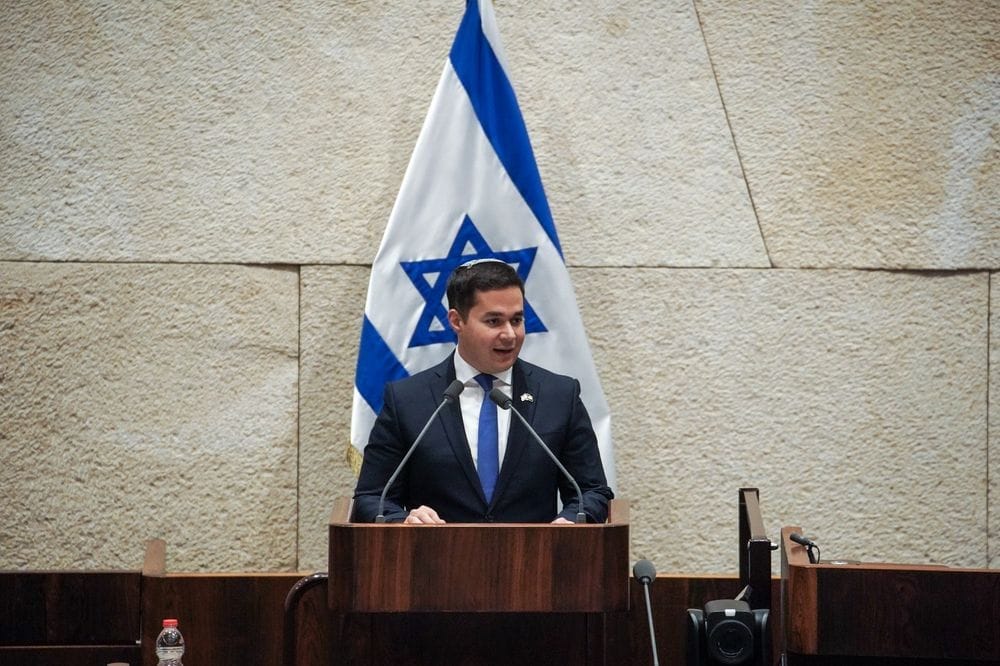
Editor’s note: Last week, Knesset Foreign Affairs and Defense Committee Chairman Boaz Bismuth, a member of Prime Minister Netanyahu’s Likud Party, presented a bill that would regulate the enlistment of young Haredi (ultra-Orthodox) men, igniting a firestorm of criticism — including from within his own party. One of the lawmakers most staunchly opposed to the bill is Likud MK Dan Illouz, who previously broke ranks with fellow party members by refusing to support legislation that would have enabled young Haredi men to avoid military service to nevertheless receive government subsidies. Illouz, 39, was born in Montreal and immigrated to Israel at the age of 23, serving as a member of the Jerusalem City Council before entering the Knesset in 2023. In this piece — his first since declaring his opposition to the current legislation — he explains why he won’t support the proposed bill and what an effective Haredi draft law would look like. Shabbat Shalom from Jerusalem. — A.M.
For nearly two years now, since the horrors of October 7, Israel has been fighting a war unlike any we have known. It is a war on seven fronts. A war that has demanded extraordinary sacrifice from the reservists who left their families and jobs, from the young men and women who put on a uniform without hesitation, and from the citizens who understand that victory is not optional — it is existential.
In such a moment, the debate over the new draft bill is not just another political argument. It is a defining test of our values as a nation and as a movement. It forces us to confront a simple but unavoidable question: What kind of country are we? And just as importantly: What kind of party is Likud?
For generations, the Likud has been the political home of the serving public. We have been the party of the soldiers, the reservists, the pioneers, the parents who send their children to defend this country, and the citizens who carry the burden of national responsibility with pride. Our party emerged from a worldview that combines freedom with duty, individual liberty with collective solidarity. That is the meaning of the national-liberal tradition.
It is precisely because I am committed to this tradition that I cannot support the draft bill in its current form. Not because I oppose compromise. Not because I seek confrontation. But because a law that fails to bring about real, historic change in the enlistment of the Haredi community is worse than no law at all.
Over the last year, we finally saw meaningful progress. The enforcement of existing sanctions — such as those related to day care subsidies — has already led to a significant rise in Haredi enlistment. That is a fact. The trend is real. For the first time in years, young Haredi men were stepping forward not because of political pressure but because incentives and expectations began to shift.
A responsible law should strengthen this progress, not reverse it.
Yet the bill in its current wording weakens the very mechanisms that proved effective. It removes key sanctions, adds exemptions that encourage avoidance rather than service, and defines the criteria for defining individuals as “Haredi” so loosely that it risks artificially inflating the number of exemptions through bureaucratic loopholes.
No national-liberal party — certainly not the Likud — can look reservists in the eyes and say this is acceptable.
Let me be clear: this is not about punishing the Haredi community. The Haredi public is a vital part of the Jewish people. I want them integrated, empowered, and fully participating in the shared responsibility of defending our homeland. I want every young man in Israel to feel that service is an honor, not a burden placed on some while others enjoy exemption.
Proper policies create incentives. They do not humiliate; they invite partnership. They change the cultural and economic structures that today make military service difficult and unattractive for many Haredi youth. And yes, they include sanctions — smart, targeted, effective sanctions — because a society cannot function if duties are optional.
The current bill does the opposite: it reduces pressure precisely at the moment when pressure is finally working.
Some argue that “unity” requires us to accept a weak law. But unity does not mean surrendering principles, and responsibility does not mean legislating illusions. A fake solution is not unity – it is escapism. A pretend draft law that enshrines inequality instead of addressing it will not calm the public; it will deepen division. It will tell the serving public — the backbone of the Likud — that their burden is invisible.
When our soldiers risk their lives, the least we owe them is honesty.
Likud voters understand this. They know that without a fair and effective enlistment framework, Israel’s security — and social cohesion — will erode. They know that a country that cannot maintain a strong, broad army cannot survive in the Middle East. And they know that the path to long-term unity between secular, traditional, religious, and Haredi Israelis is not built on denial but on shared responsibility.
Some in the political system hope that if they pass any law, even a weak one, the public will move on. But the public will not forget. The reservists will not forget. The nationalist, Zionist majority inside Likud will not forget.
And they will ask: Where were you when Israel needed courage — not “formulas”?
My position is simple:
We must pass a real draft law — not one that evaporates on contact with reality.
A law that:
Maintains and strengthens the sanctions that have already proven effective;
Prevents manipulation by accurately defining who qualifies as Haredi;
Creates real incentives for service – economic, educational, and professional; and
Ensures that Israel will have the manpower necessary to win in every arena.
This is not extremism. This is responsibility. This is Zionism. And this is the Likud.
I know some prefer to avoid this confrontation. I understand their discomfort. But leadership is not measured by avoiding debates — it is measured by choosing the right side of them.
This moment calls for clarity. It calls for honesty. It calls for a renewal of the national-liberal spirit that once defined the Likud and must define it again.
We must remain the party of the serving public. The party of national responsibility. The party that understands that without victory, there can be no Israel — and without a strong, shared IDF, there can be no victory.
I will fight in committee for a historic law. I will work with every Zionist Member of Knesset in the coalition to ensure that the final bill is one that strengthens the army, strengthens national unity, and strengthens the Likud’s commitment to the serving public.
If we pass a law that meets these principles, I will proudly support it. If not, I will oppose it — because loyalty to the movement means loyalty to its values.
This is not a moment for political maneuvering. This is a moment for a moral stand. And I am taking that stand.
For our soldiers.
For our movement.
And for the future of the State of Israel.
Dan Illouz is a Member of Knesset on behalf of the Likud Party. He formerly served as a member of the Jerusalem City Council. Born in Montreal, he immigrated to Israel in 2009. He lives in Jerusalem.


 | A guest post by
|
I’m glad that another coalition member does what’s right. I’ve just published an article about Haredi fighters in Israel’s War of Independence, and it shows that the current reality is not the only possibility…
https://open.substack.com/pub/floritshoihet/p/guns-and-shtreimels-the-forgotten?r=6j4gxc&utm_medium=ios