
A Country Worthy of Their Sacrifice
As Israel transitions from Memorial Day to Independence Day, we must ask how we can build a country that honors those who gave their lives in its defense

“It has been approved for publication.”
They are the most dreaded words in the modern Hebrew language, familiar to every Israeli. They cause listeners to pause and hold their breath as they await what they know is coming. They are the words with which television anchors, radio broadcasters, and news websites announce that another soldier has been killed in action.
Each year, just before Yom HaZikaron — Israel’s Memorial Day, which takes place today — the Defense Ministry and the National Insurance Institute release a macabre tally of soldiers killed in the line of duty and civilians killed in terror attacks over the past year, since the previous Yom HaZikaron.
According to this year’s announcement, 170 soldiers and 79 civilians have been killed over the past year and 54 former service members died of wounds sustained during their military service. In total, 25,644 individuals have been killed fighting for Israel’s establishment and in its defense since 1860. The circle of bereavement consists of 59,583 family members of the fallen, including 31,814 siblings, 14,430 orphaned children, 8,420 parents, 4,872 widows and widowers, 35 legal guardians, and 12 fiancées. 4,587 individuals, including 810 children and teenagers, have been killed in acts of terror since Israel’s establishment in 1948; nearly a quarter of them — 1,017 — were killed on or since October 7, 2023. Today there are 99,156 victims of terror living in Israel and 14,815 bereaved family members, including 4,932 orphaned children.
The numbers are too enormous, too overwhelming, and too horrific to comprehend. They are also incomplete.
Since the announcement was issued on Thursday, two more soldiers have lost their lives, both in southern Lebanon.
Warrant Officer Barak Kalfon, 48, was killed when a boobytrapped building exploded in the town of Tibnin. He left behind a wife and two teenage daughters. His mother said he insisted on continuing to perform reserve duty as a paratrooper despite his age. “Mom, you have to understand — there aren’t enough soldiers,” he told her. “I have to keep serving. There’s no choice.”
Sergeant First Class Lidor Porat, 31, was killed on Saturday when a military vehicle was blown up by a Hezbollah IED. He left behind a father and two siblings, including a twin sister; his mother passed away several years ago. “Lidor was the best friend you could ask for,” a friend recalled. “He was always smiling; all he wanted to do was live, to learn and laugh.”
Walking through the streets of Israel, it is impossible to miss the human cost of maintaining our existence in this land. Bus stops, lampposts, street signs, and train stations are plastered with bumper stickers bearing the smiling young faces of fallen soldiers and quotes by or reminiscent of them. From time to time, I will see the face of a soldier I knew personally and send a photo to his parents.
Israel is a tiny country, smaller than some metropolitan areas in the United States; there are few, if any, Israelis who have not experienced the death of a loved one, a friend, a classmate, a neighbor, or some other acquaintance in war or an act of terror. The sense of loss, the painful awareness of young lives cut short in their prime, is both pervasive and deeply personal.
Yom HaZikaron is a day to remember those who gave their lives so we could live. As others have put it, if Yom HaShoah — Holocaust Remembrance Day, which we marked last week — commemorates the price of not having a Jewish state, Yom HaZikaron memorializes the price of having one.
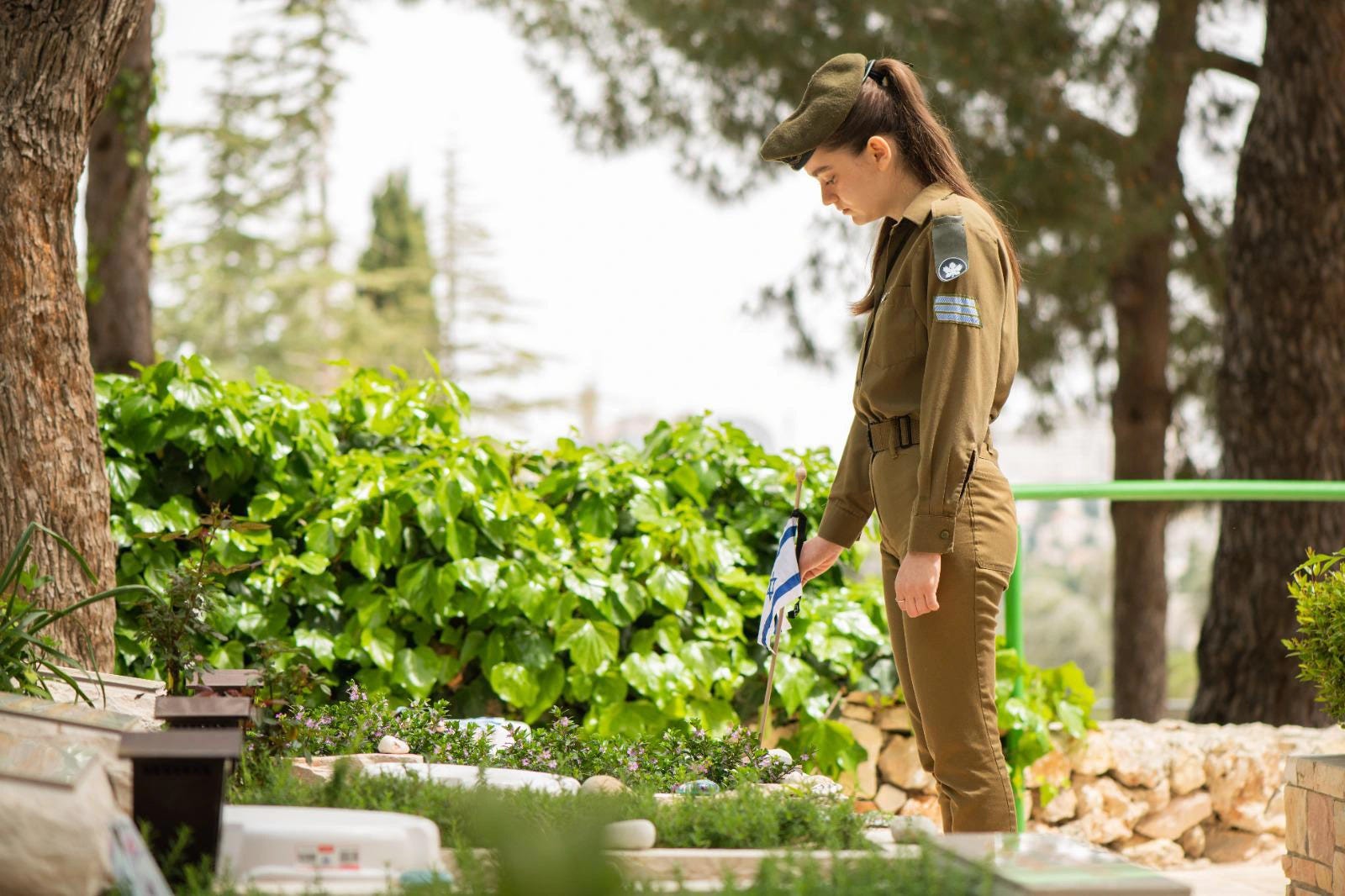
As the sun hangs low in the sky, the hundreds of thousands of Israelis who spent the day visiting the gravesites of loved ones in military cemeteries across the country are making their way home to prepare for Yom HaAtzma’ut, Israel’s 78th Independence Day, which begins at nightfall.
The transition from solemn remembrance to exuberant celebration is sharp and disorienting, but the message is unmistakable: it is the sacrifice of Israel’s fallen soldiers that brought the country into being and enables its continued existence.
And it is in this twilight moment, in these quiet hours of suspended existence, that we have to ask how we can ensure that this country continues to be worthy of that sacrifice.
Israel’s Declaration of Independence, adopted in Tel Aviv on a Friday afternoon 78 years ago tomorrow, sets out a vision of a state that is at once proudly Jewish and robustly democratic, that ensures fundamental rights for all its citizens and pursues peace with its neighbors, that joins hands with Jewish communities around the world and takes its place among the family of nations, a state “based on freedom, justice, and peace, as envisaged by the prophets of Israel.”
We must ask, today and every day, whether we are living up to that vision.
The Israel of today is a marvel that, in many ways, surpasses what its founders may ever have imagined. Its population has grown more than tenfold since 1948, fueled by aliyah (immigration) from more than 150 countries and by the highest birthrate in the developed world. It is a regional superpower, with one of the most capable militaries on earth, its planes flying deep into hostile territory to eliminate distant threats. It is an economic powerhouse, its tech sector celebrated by the world’s leading corporations, its stock exchange hitting record highs even in the midst of war. It is a vibrant, diverse society whose citizens are consistently ranked among the happiest in the world.
But the Israel of today is also a country beset by profound internal challenges.
Deep divisions in Israeli society are being widened and exploited by those who should be working to heal them. Basic norms are breaking down, corruption and unaccountability are becoming normalized, and the democratic foundations of the state are under sustained pressure. Public discourse has grown more hateful. Inequality persists between those with access to power and those without. There is a strain of racist, violent extremism that is being tolerated, and at times encouraged, by senior figures in government. It increasingly feels as though the country is made up of parallel societies that are resentful of one another, have little common ground, and are growing further apart.
These societal ills are serious and corrosive, but they can be healed. A country that rose from the ashes to become an example to the world, that defied the odds to secure its sovereign existence, and that continues to produce young men and women willing to lay down their lives in its defense is equal to the task of national repair.
But it is a choice we must make.
We are in a period of national reckoning, a time in which we must decide what kind of country we wish to be. In the months ahead, there will be many who will seek to further inflame internal tensions, who will conjure up dark visions of a country defined by hatred and fear, and who will prey on our basest instincts for political gain.
We must not permit them to succeed.
Instead, we should lend our voices and our votes to those who will do the difficult but necessary work of mending divides, strengthening governance and civility, promoting dignity and equality, and making this country more Jewish and more democratic.
It is perhaps notable that this week’s Torah portion is Acharei Mot, which translates as “After the Death,” referring to the killing of Aaron’s sons, Nadav and Avihu, by a divine flame. When Aaron, the High Priest, is informed of his sons’ death, he responds stoically — “And Aaron was silent” (Leviticus 10:3) — offering an example that we echo today in the moments of silence observed on Yom HaShoah and Yom HaZikaron.
But the portion does not dwell on grief. It turns, instead, to what comes next: a detailed description of the Yom Kippur service, for which Aaron must purify himself and don special garments.
The order of events may seem confusing at first, but a closer look reveals a sequence of poignant elegance. On Yom Kippur, the fate of the entire nation hangs in the balance. Aaron, who has just experienced profound personal loss, is called to approach the task of atoning for the people’s sins with precision and care. Perhaps only someone who knows from immediate personal experience how high the stakes are, and what can be lost, can truly comprehend the gravity of serving a people and shaping its future.
There is nothing more sacred than life itself. We owe it to the families who entrust their sons and daughters to the state — and whose children endanger and, at times, give their lives for that state — to ensure that it is truly worthy of that most precious gift.
Tonight, as we pop champagne corks and toast the 78th anniversary of our national independence, let us resolve to build a country that embodies our highest values, in which all segments of society feel equally at home, of which all Israelis and Jews around the world can be proud, and which honors those who made the ultimate sacrifice in its defense.


