

When Fear Stopped Working in Iran
Iranian-born human rights activist Marjan Keypour Greenblatt describes how a regime built on martyrdom lost its hold on a new generation

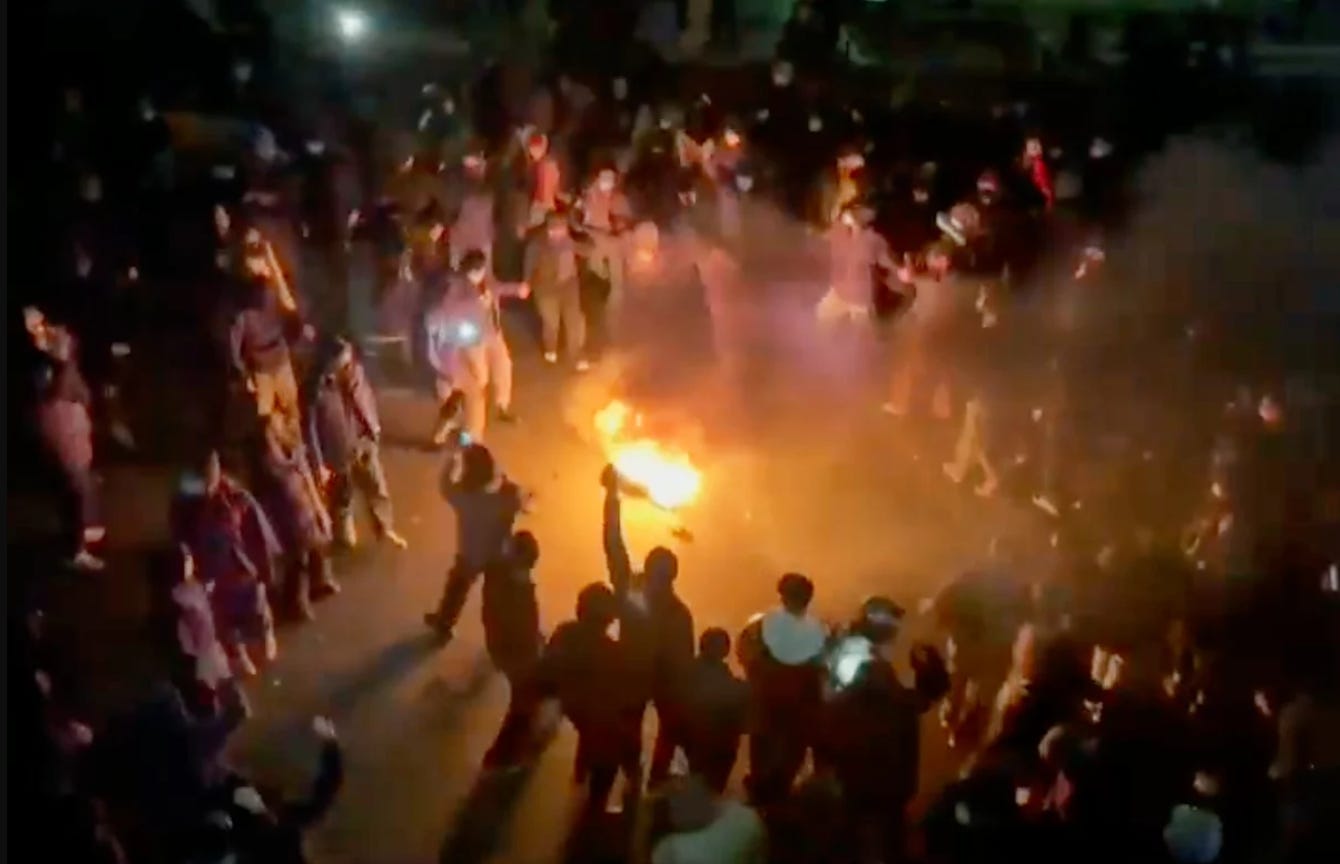
Editor’s note: As the dramatic events of recent weeks continue to unfold in the streets of Iran, gripping the world's attention, we invited Iranian-born human rights activist Marjan Keypour Greenblatt to reflect on the origins of the current wave of protest — and why things will never go back to the way they were. I know you will find this piece as timely and moving as I did. Shabbat Shalom from Washington, D.C. — A.M.
I remember the dark days of the war with Iraq.
I was a middle school student attending a government-run public school in Tehran, where a full day of moral education was intermittently interrupted by math and science. I would come home to radio and television programming blaring military marches, mournful Quranic recitations, and daily announcements listing the names of dozens of young soldiers killed at the front. Many were my peers — boys between the ages of 12 and 21 — who had enthusiastically enlisted. They were promised a better life in heaven: seventy-two virgins, divine reward, even metallic keys to paradise worn proudly around their necks.
In the years that followed, these “martyrs” were immortalized in street names. Their families received government subsidies and special favors, woven into a system that rewarded sacrifice with material and symbolic recognition.
Nationalism ran deep, but it was intertwined with something stronger: a fantasy of salvation in the afterlife. I, too, absorbed this belief. I would tell my parents, “I’m not afraid of death. Death is an honor for those who love their country.” I was thirteen, a Jewish girl who despised the regime — the compulsory hijab, the suffocating propaganda, the omnipresent fear, the absence of freedom. Yet had I been a boy, I might have secretly enlisted to fight for Iran — not for the regime, but for the nation.
This fusion of nationalism and spiritual idealism proved immensely powerful. The former is distinctly Iranian; the latter Islamic. Together, they sustained Iran through seven years of war with Iraq.
The Islamic Republic became highly skilled at cultivating and exploiting these emotions. Manipulation was easier in a country that controlled every word of its educational curriculum, broadcast media, cultural production, and — later — much of its digital space. Through these instruments, the regime justified its failures and advanced its narratives. Over the past 47 years, it framed the hijab as protection against sexual assault, blamed American imperialism for global poverty, cultivated selective compassion for Palestinians, equated nuclear development with national pride, portrayed child marriage as maturity, and pacified hunger with promises of a better life in the afterlife.
But as the regime pulled emotional strings, the world changed. Technology cracked open the information ecosystem, and a new generation of literate, tech-savvy Iranians gained access to alternative narratives. Armed with information, young people rebelled against state-imposed norms. They pushed back against restrictions, demanded dignity, and openly mocked their inept rulers. A nation long defined as a religious entity witnessed a quiet but profound rejection of Islam — and, for many, of religion itself.
This shift extended even to identity. Young people changed their names from Ali, Mohammad, and Zahra to Ardeshir, Kourosh, and Manijeh — shedding Islamic markers to reclaim pre-Islamic Iranian roots.
Politically, faith in the system collapsed. Once a vibrant electorate, reaching a peak of 85% participation in 2009, turnout fell to 73% after the failure of the Green Movement, to less than 50% in the cycle before Mahsa Amini’s murder, and finally to less than 40% — its lowest point, at which the current president, Pezeshkian, was elected. Iranians came to understand that their votes had little impact on their lives; they served instead as propaganda, enabling the regime to claim legitimacy abroad.
The nature of protest evolved, as well. In 2017, during what became known as the Dey Protests, demonstrators in the religious city of Mashhad chanted, “No fear, no fear, we are all together.” In a totalitarian system where neighbors fear one another and informants thrive, the chant was transformative. Until then, many Iranians believed Mashhad firmly supported the regime.
By 2018, the slogans reflected a deeper political awakening. Protesters chanted, “Our enemy is right here; they lie when they say it’s America.” The rhetoric grew sharper, even extending to foreign policy: “Neither Gaza nor Lebanon — my life is for Iran,” and more recently, “Both Gaza and Lebanon shall be sacrificed for Iran.”
Iranians were losing faith in both God and government. The 2022 murder of Mahsa Amini — arrested for refusing to wear her hijab and beaten to death in police custody — marked a breaking point. Promises of heaven no longer compelled obedience and fear no longer restrained defiance. This was the moment many women rejected compulsory hijab altogether, reversing the equation of fear — daring morality police to arrest them.
The Woman, Life, Freedom Movement launched after Amini’s killing is filled with snapshots of fearless resistance: women intimidating security forces with uncovered hair; young people following clerics and knocking their turbans into the street; protesters hurling tear gas canisters back at their attackers; buildings set ablaze. They fought back knowing the risks — arrest, torture, death. Fear had lost its power.
Life for the Iranian people did not improve after the 2022 protests. The economy tanked to new lows, inflation skyrocketed, and the basic necessities of life — even clean air, water, and electricity — became scarce. Freedoms were promised but never delivered. Whatever liberty people exercised, like walking around without the hijab, was a moment of freedom earned at great risk. They lost hope in their government and God, but they found faith in themselves.
With fear gone and power regained, more people took to the streets. This is how the current wave of protests has emerged as the largest since the 1979 revolutionary uprising. “Death to the dictator,” they chant, “Javid Shah: long live the king” — slogans that challenge the foundation of the revolution in its entirety. A return to the beginning.
From the accounts of people who left videos behind, it is clear they were aware of the dangers they faced — the very real possibilities of arrest and death. But they wanted to redeem their dignity and fight for their own rights.
To quell the people’s rage, the government promised extra subsidies and food to the public. That pathetic act of charity offended the protesters. They have taken to the streets with their treasured bags of rice and thrown the contents into the air, rejecting the regime’s pitiful efforts to calm their decades-long struggle with a little bit of money. It was too late. The regime has destroyed so much and taken away so much that nothing can pacify these people.
The Iranian people are not motivated by promises of the other world should they be shot; instead, they express their love for their country and urge the importance of saving it — even at the cost of their lives.
I know one thing for sure. If I were in Iran today, I would be among the protesters, fighting for exactly what my brothers and sisters are fighting for — even if it cost me my life.
Marjan Keypour Greenblatt is a human rights activist and advocate for women and minorities in Iran. Born and raised in Iran, she is the Founder and Director of the Alliance for Rights of All Minorities (ARAM) and StopFemicideIran.org, the first interactive map documenting acts of femicide in Iran and memorializing the victims. A non-resident scholar at the Middle East Institute, she holds a degree in sociology from UCLA and a Master’s in education from Harvard University.


 | A guest post by
|
I didn’t know young people are changing their names to pre Islamic ones… wow; thanks for sharing, this is my take : please restack, should you find it interesting https://open.substack.com/pub/mahnazhatami/p/fear-a-mother-who-dances-over-her?r=6a6pnp&utm_medium=ios