

On the Day I Make Aliyah
As he leaves Britain to begin a new life in Israel, author Ben M. Freeman — founder of the modern Jewish Pride movement — reflects on Jewish identity, peoplehood, and the meaning of returning home

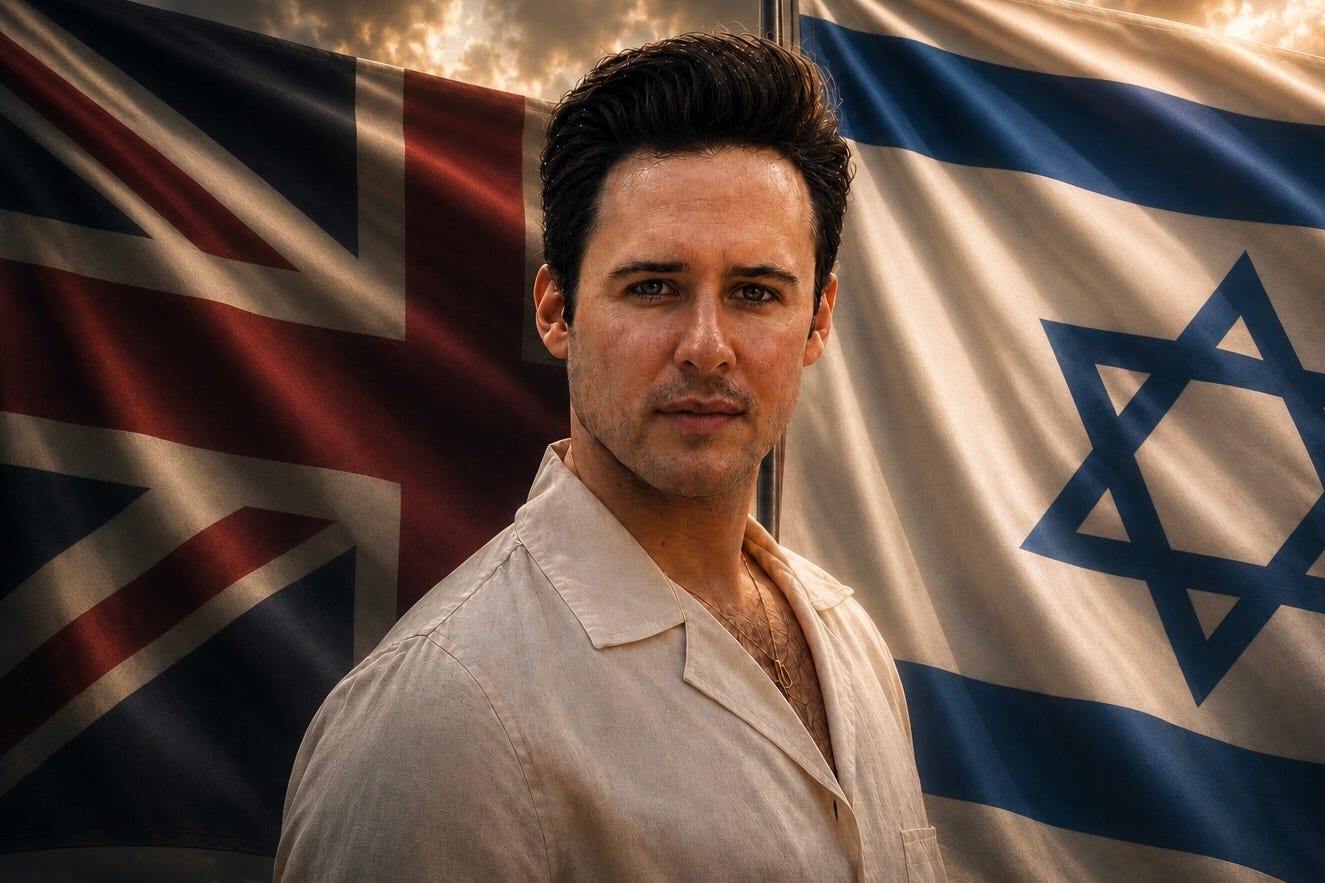
Editor’s note: Antisemitism in the United Kingdom has reached levels not seen in generations, prompting renewed questions about the place of Jews in British society. Today, the British Jewish author and public intellectual Ben M. Freeman is making Aliyah. We invited him to reflect on this milestone — not only in his own life, but also in the broader conversation about Jewish belonging, identity, and the relationship between Diaspora Jewry and the State of Israel. — A.M.
In 1945, George Orwell wrote his famous essay, “Antisemitism in Britain.” It was a searing examination of Jew-hate in the UK just as the Second World War was drawing to a close and the full horrors of the Holocaust were becoming widely known.
For a period, as in much of the Western world, overt Jew-hate was driven underground in Britain. I was born at the tail end of this post-Holocaust era. Although my late father tried to warn me that the non-Jewish world still hated Jews, I pushed back. I did not believe him. Although I knew Jew-hate had not disappeared, I would tell him, “Things have changed, Dad.”
The events of the last decade, from the Corbyn crisis to the aftermath of October 7, have proven that my father was right and that much of what Orwell described still rings true today. At a certain point, the cumulative effect becomes impossible to ignore. For this reason, I have decided to leave the UK and make Aliyah.
This is not a conclusion I reached lightly. As a former Holocaust educator and the author of three books on Jewish Pride and Jewish indigeneity, I have spent years thinking and writing about Jew-hate, Jewish identity, and the Jewish people’s relationship to the Land of Israel. Precisely because I have spent so much time engaged with these questions, I do not make this decision casually.
Yet none of this is merely academic. I was born in Britain. I hold a British passport. Britishness is woven into who I am. I learned about its kings and queens as my own history. I was raised on its culture, humor, and traditions. Although my Jewishness and connection to Israel were always central to my identity, I still felt deeply British.
Despite this, there is a particular exhaustion that many Diaspora Jews understand: the exhaustion of constantly feeling the need to justify yourself, defend your legitimacy, moderate your visibility, and accept scraps of acceptance as though they are acts of generosity. Many Jews in the Diaspora know this feeling, even if we rarely articulate it.
October 7 and its aftermath shattered something for many of us. We watched crowds celebrate the massacre of Jews. We watched support for Hamas and other extremist groups become normalized in activist spaces and on the streets of our cities. We watched Jewish fear become something to debate, minimize, mock, or explain away.
What troubles me most is not simply the existence of anti-Jewish hatred. Jew-hate has existed in every society where Jews have lived. What troubles me is how normalized certain forms of it have become in contemporary Britain.
Part of the answer lies in a longstanding failure to understand Jew-hate itself. Too many politicians and public figures still view it exclusively through the lens of twentieth-century fascism. They recognize the Nazi with a swastika. They are less willing to recognize anti-Jewish prejudice when it emerges from ideological movements they otherwise sympathize with, or when it is wrapped in the language of anti-racism, anti-colonialism, or activism. When anti-Jewish prejudice appears on the political Left, it is frequently dismissed as confusion over Israel rather than confronted on its own terms.
Britain has also struggled to confront forms of anti-Jewish extremism that exist within parts of its Muslim population. Yet for years, many politicians, commentators, and public institutions have treated these realities as effectively undiscussable. The result has been a culture of evasion in which difficult conversations are postponed, extremism is reframed as grievance, and those who raise legitimate concerns are often treated as the problem rather than the problem’s messenger.
Many British Jews increasingly feel that the institutions responsible for protecting them neither understand the threats they face nor possess the confidence to confront them. There comes a point where you realize that you have spent years trying to persuade yourself that tolerance is the same thing as genuine belonging. I no longer want to live that way.
The issue is not whether British Jews have integrated. We have. British Jews have contributed to every aspect of national life. We have served in Parliament, in the armed forces, in medicine, business, culture, and public service. Every Shabbat, many synagogues still recite a prayer for the King and the Royal Family.
But ultimately, none of this should matter. A Jew born in Britain should not have to justify his or her place in British society any more than anyone else born here. We should not have to point to our contributions, our patriotism, or our loyalty in order to establish that we belong. We are British. That should be enough.
The question is not whether Jews have demonstrated loyalty. The question is why we are so often expected to keep proving it. A society that continually demands demonstrations of loyalty from a minority can never fully become that minority’s home.
Yet focusing solely on what I am leaving behind would miss an equally important part of the story. If rising Jew-hate in Britain explains why this decision feels urgent, it does not fully explain why I am making it.
In many ways, my decision is also the logical conclusion of my own journey. Through my work on Jewish Pride, I came to believe that Jews should define themselves through their own history, identity, and peoplehood rather than through the prejudice directed against them. That belief has not changed. If anything, it has deepened.
I believe that Jews must see themselves not merely as victims of Jew-hate, but as a people with a civilization, a culture, and an indigenous homeland. Indeed, it is precisely because I believe this that I refuse to ignore the realities facing Jews in Britain today. Jewish Pride requires confidence, but it also requires honesty. It asks us to see both ourselves and the world clearly. My decision to make Aliyah is rooted in both realities.
For two thousand years, Jews maintained an unbroken connection to the Land of Israel through prayer, ritual, memory, language, and national consciousness. Even in exile, we never regarded ourselves as adherents of a religion detached from land and peoplehood. We remained a nation dispersed from its homeland. Jerusalem was never just a metaphor. Zion was never just an abstraction.
Much of my recent work has focused on Jewish indigeneity, and that work has only reinforced what Jews themselves have always known: our connection to the Land of Israel is not merely theological or symbolic. It is the connection of an indigenous people to its ancestral land.
For centuries, Jews maintained that connection despite exile, persecution, and repeated efforts to sever us from our history. The modern State of Israel is not the beginning of that story. It is the latest chapter in it.
Today, for the first time in two millennia, Jews once again have sovereignty in that land. The modern State of Israel represents the re-establishment of Jewish self-determination in the land where Jewish civilization emerged. For the first time in centuries, Jews are not only a minority in someone else’s society; we are participating in the development of our own.
Some will ask why I am making this move in the middle of a war. The answer is simple: if Israel is home, then it is home in times of war as well as peace. Waiting for perfect certainty would mean waiting forever.
I am not making Aliyah because I believe life in Israel will be free from challenges. Rather, I am making Aliyah because, as a Jew in the twenty-first century, I possess a privilege that most previous generations of Jews could scarcely imagine.
For most of our history, Jews fleeing persecution could only move from one Diaspora community to another, exchanging one uncertainty for a different one. I have a different option. I can leave a country where Jew-hate is becoming increasingly normalized and return to the indigenous homeland of the Jewish people.
I can live in the place where Jewish civilization emerged, where Hebrew is spoken in the streets, and where Jewish life is lived openly rather than constantly negotiated with others. I can help build the future of the Jewish people in the place where our story began.
For most of Jewish history, returning home was a dream. For my generation, it is a choice.
Today, I made mine.
Ben M. Freeman is the founder of the modern Jewish Pride movement and is the author of Jewish Pride: Rebuilding a People, Reclaiming our Story: The Pursuit of Jewish Pride, and The Jews: An Indigenous People. He is a research fellow at the Elizabeth and Tony Comper Center for the Study of Antisemitism at the University of Haifa. Born in Glasgow, he has lived in Hong Kong and London and is making Aliyah to Tel Aviv.


 | A guest post by
|
A brilliant article, well compiled and executed. Thank you.
Institutions like the BBC, the Metropolitan Police, other regional police forces, the CPS and many politicians, have failed in their duty to understand and protect Jewish people. Likewise their views on supporting palestinian causes is blindsided by prejudice, ignorance and fashion.
The spouting by Starmer and others that there is no place for antisemitism is just words, full of inaction.
Welcome home 💙🇮🇱