

The Stories That Warn Us Before It's Too Late
Artist Eli Kaplan Wildmann explains why the Talmud's account of Jerusalem's destruction places us before the catastrophe — not after it — and what that can teach us today

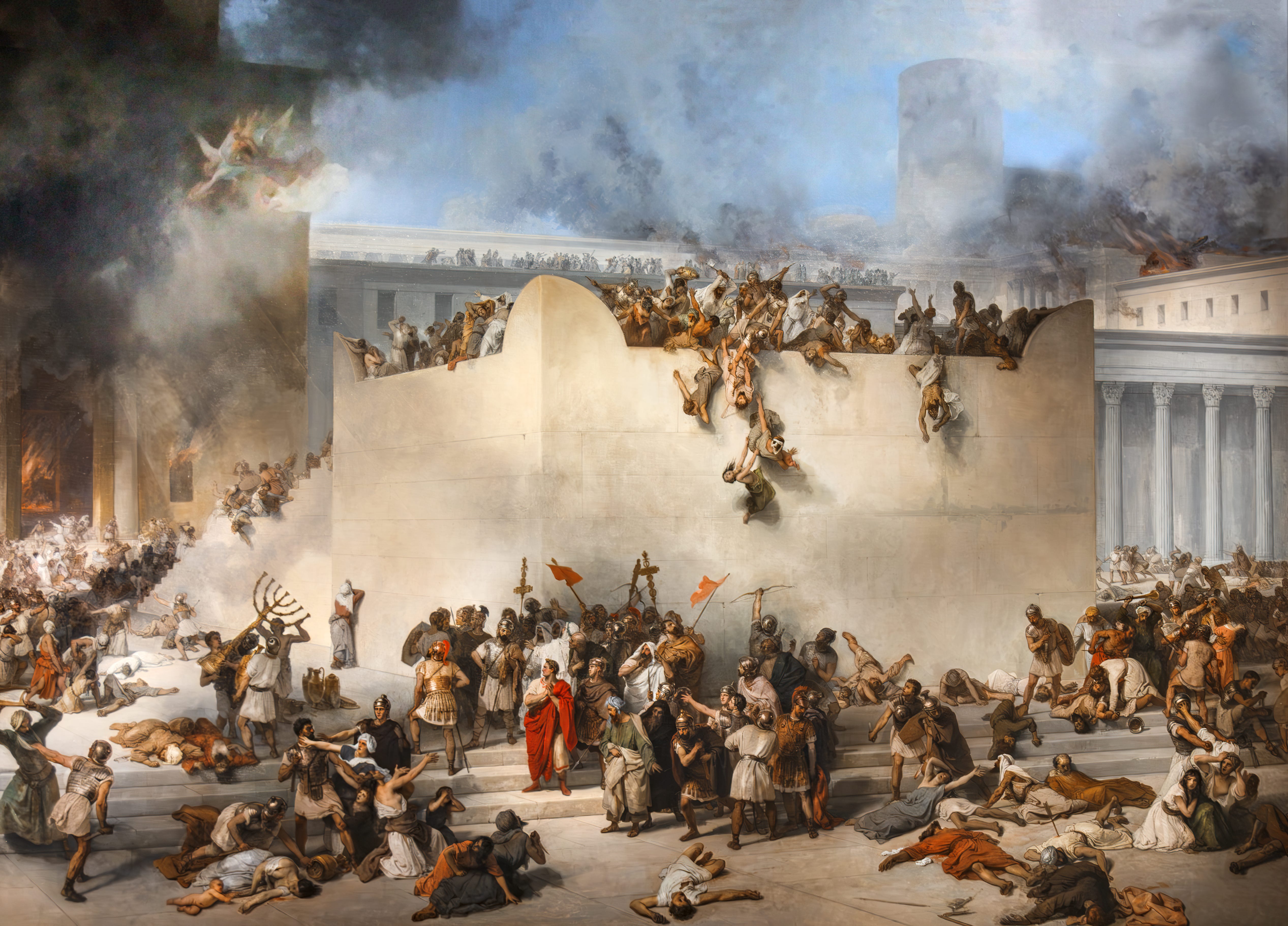
Editor’s note: As we observe Tisha B’Av, we mourn the destruction of Jerusalem while reflecting on the choices that made that destruction possible. In this guest essay, Jerusalem-based artist and designer Eli Kaplan Wildmann explores what he learned while writing Sacrifices, a new musical inspired by the Talmud’s Tales of the Destruction, and why those stories remain as urgent today as they were nearly two millennia ago. An easy and meaningful fast to all. — A.M.
When setting out to make the Hollywood blockbuster that premiered in 1997, director James Cameron endured endless ridicule. Why make a movie that everyone already knows will end with the ship sinking, the critics asked. He surely got tired of hearing that question.
Eventually, though, watching Titanic become a record-breaking box office and cultural phenomenon must have drowned out the detractors. Cameron’s layered storytelling, intertwining the past and the present, caused this tragedy about an “unsinkable” ship to take flight.
Tisha B’Av, the fast day on which we commemorate multiple tragedies in Jewish history, most prominently the destruction of Jerusalem’s First and Second Temples, is a day for contemplating stories with inevitable tragic endings. The Babylonian Talmud, in Tractate Gittin, contains the “Tales of the Destruction,” a collection of stories that all end with Jerusalem and the Temple being laid to waste. The Temple in question is the Second Temple, the crown jewel of the bustling, wealthy, and cosmopolitan metropolis that Jerusalem was in 70 CE.
I live in Jerusalem, which today is once again a bustling metropolis, home to a wealth of people from every walk of life. To me, it is Israel’s cultural capital, its greatest wellspring of inspiration and creativity. I love this city. I love creating here as an artist and designer, and I am very excited to finally be releasing into the world my own creation about it. Along with wonderful collaborators, I am writing a musical based on the very Tales of the Destruction that we contemplate on this solemn day.
How can I be writing a show in which, like Titanic, everyone already knows the ending? The Temple is destroyed, and the audience comes in knowing that. Some people will also know one of the best-known Tales of the Destruction, the story of Kamtza and Bar Kamtza, which forms the backbone of the musical.
At a large banquet among ancient Jerusalem’s elite, where everyone who was anyone had gathered, the wrong guest appears. Instead of the host’s friend Kamtza arriving, Bar Kamtza, the host’s sworn enemy, is accidentally invited. The host throws him out. Bar Kamtza begs not to be publicly humiliated, offering to pay for more and more of the banquet if only he can stay, but to no avail. The humiliation he endures drives him to bring about the city’s downfall.
Who is the villain in this story? Is it Bar Kamtza, who is said to have brought about the city’s destruction? Is it the unnamed host and his cruelty? Traditional teachings about the story, and our theatrical retelling, are most interested in imagined villains who are not even mentioned in the text: the silent tables full of Jerusalem’s leading citizens, the powers that be, watching the humiliation unfold without intervening.
Of course, that raises another question: did it actually happen?
The Talmud is not generally known as a historical volume. For straightforward historical accounts, we tend to turn to Josephus, the Jewish military commander turned Roman historian who wrote extensively about the period. As we worked on the script for our show, we decided to draw from both the Talmudic tales and Josephus’s descriptions. We soon discovered that they don’t always align. The order of events differs, and characters who appear in one version cannot always fit into the other. Faced with two compelling but conflicting accounts, we had to decide which version to tell.
The answer might be back on the deck of the Titanic.
What made Titanic so gripping wasn’t the ending. As wealthy elites and hopeful immigrants boarded the ship, our eyes were riveted to the screen not because they knew they were part of history’s most infamous maritime disaster, but because they didn’t. They weren’t boarding a symbol of hubris. They believed they were stepping onto the safest ship ever built.
The question of what kind of ship are we on today matters only if we’re willing to ask whether we recognize the icebergs that may lie ahead.
The Tales of the Destruction are retold every year by teachers, rabbis, and artists. They are stories of people who couldn’t see that they were heading toward disaster, people who sat silently as others were humiliated, people who saw conflict without realizing it was only the visible tip of much deeper and more dangerous problems below the surface.
There is a gradual subversion of expectations in Sacrifices, the show I am writing, a realization that may surprise audiences. It almost feels as though this is where I should offer a spoiler warning. But in truth, the realization shouldn’t surprise us at all.
The Romans destroyed the Temple. But these stories insist that Jerusalem had already begun destroying itself.
The Jews of Jerusalem were aware of the animosity between their different classes and belief systems, the compartments each group had built for themselves. But they never imagined those compartments would fill with enough hatred to allow Jerusalem to go under.
The greatest surprise came during our writing process, when we had to decide which version of the story to tell. As a by-the-book stickler, I instinctively favored the historical account over the Talmudic one. History felt like the “correct” choice. But as we wrote, and as we workshopped the show, the Talmudic version consistently proved stronger.
Today, on Tisha B’Av, I am reminded why.
The Sages who sat down after the destruction to write these tales had a clear purpose. They weren’t simply recording what had happened. They were writing to teach us, to speak to us, and to speak to every future generation that might one day find itself in similar circumstances. This tragically earned wisdom is there to help prevent future loss.
The challenge of Tisha B’Av, and the call to action embedded in these stories, is to stop imagining ourselves only as the mourners after the destruction. The harder task is to imagine ourselves as the people who were certain destruction would never come.
This way of telling stories, placing us before tragedy rather than after it, is part of our inheritance. Our Sages understood that mourning the past was not enough. If future generations were to avoid repeating it, they first had to recognize themselves in the people who believed disaster could never come.
That inheritance is also a gift we can offer today’s polarized and fractured world. At a time when Jews are so often maligned and rejected by those around us, we possess a tradition that transforms tragedy into responsibility, memory into empathy, and grief into hope. By looking honestly at catastrophe and allowing it to inspire greater kindness, humility, and unity, we can first strengthen ourselves, and then bring that same lesson to a world that so desperately needs it.
Eli Kaplan Wildmann is an artist and designer based in Jerusalem. Sacrifices will be performed this December at the Orensanz Foundation, a restored Gothic synagogue built in the 1800s on New York City’s Lower East Side. Learn more at sacrificesthemusical.com.


 | A guest post by
|